First Aid for Babies: The Basics Every Parent Needs to Know
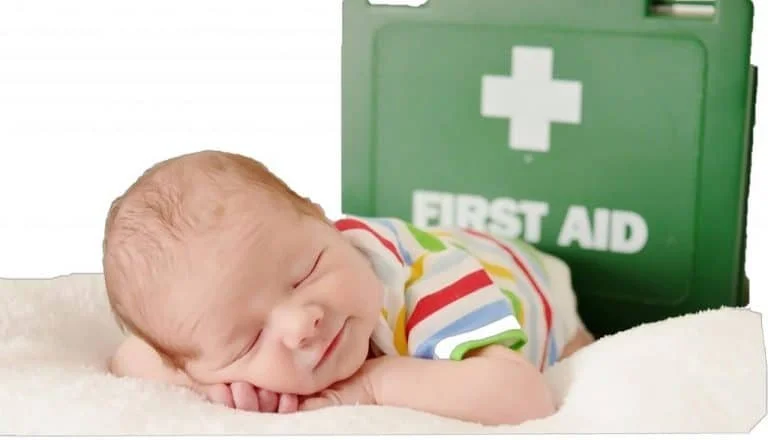
You do not need to be a medical professional. You need to know enough to act calmly and quickly in the first minutes.
Baby first aid is one of those things that feels overwhelming to think about and genuinely empowering once you know it. The basics are learnable. They are worth learning before you are in a situation where you need them.
This is an overview. It is not a substitute for a certified first aid course, and there is a specific infant CPR and choking course designed for parents that is worth doing before your baby arrives. Enrol in one. It is a few hours and it will stay with you.
If your baby is unresponsive and not breathing
Call emergency services immediately (000 in Australia, 111 in NZ, 999 in the UK, 911 in North America) or have someone call while you begin CPR.
For infants under 12 months:
– Lay your baby on a firm, flat surface
– Tilt the head back very slightly to open the airway (less than you would for an adult)
– Cover both the nose and mouth with your mouth and give 5 gentle initial rescue breaths
– Begin chest compressions: use two fingers on the centre of the chest, just below the nipple line
– Push down approximately one third of the chest depth, 30 times, at a rate of roughly 100-120 per minute
– Follow with 2 rescue breaths, then repeat the 30:2 cycle
– Continue until the baby responds, emergency services arrive, or you are physically unable to continue
If your baby is choking
An effective cough is always the first response. If your baby can cough forcefully, encourage them to keep coughing. If the cough becomes ineffective or silent, act immediately.
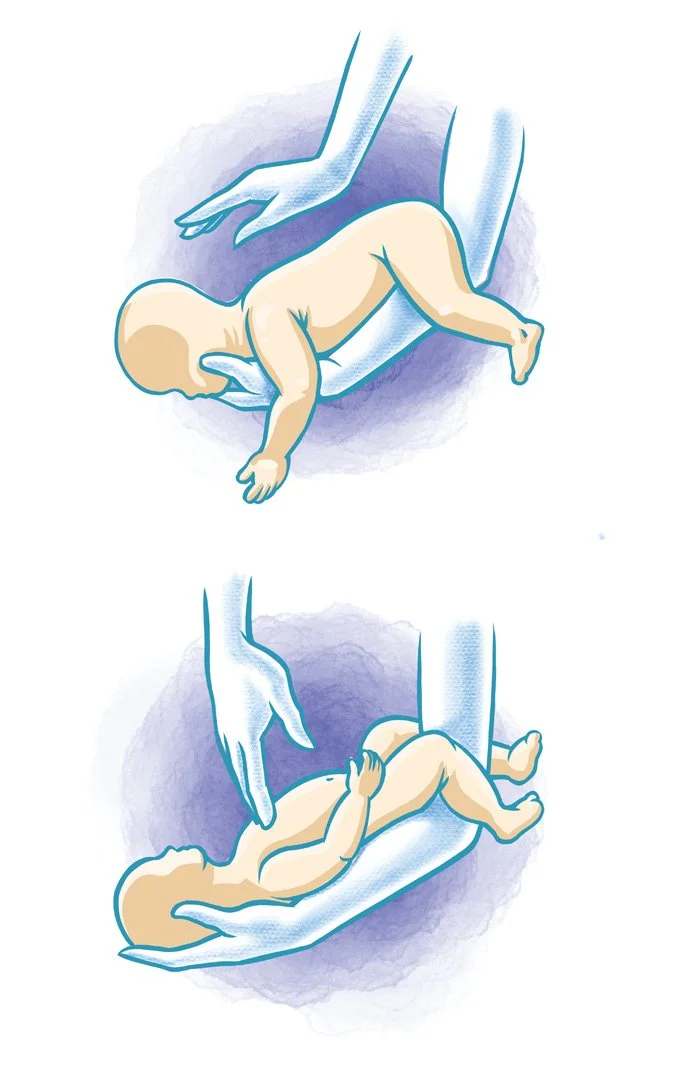
– Hold your baby face down along your forearm, supporting the head
– Give up to 5 firm back blows between the shoulder blades with the heel of your hand
– Check the mouth after each blow and remove any visible obstruction
– If back blows do not clear the blockage, turn your baby face up on your thigh
– Give up to 5 chest thrusts: two fingers on the centre of the chest, pushing inward and upward
– Alternate 5 back blows and 5 chest thrusts until the airway clears or emergency services arrive
Do not do blind finger sweeps in an infant's mouth. You can push an obstruction further in.
If your baby has a fever
A fever is a temperature above 38 degrees Celsius (100.4 Fahrenheit). In babies under 3 months, any fever is a reason to seek medical attention immediately without waiting.
In older infants, assess the whole picture: how does your baby look? Are they responsive, making eye contact, able to be settled? A baby who is alert and consolable is different from one who is limp, unusually quiet, or has a rash that does not fade under pressure.
When in doubt, call your GP, nurse hotline, or emergency services. Trust your instincts about your own baby.
If your baby has a burn
– Cool the burn immediately with cool (not cold) running water for a minimum of 20 minutes
– Remove clothing or nappies near the burn if they are not stuck to the skin
– Do not use ice, butter, toothpaste, or any home remedy
– Cover loosely with cling wrap
– Seek medical attention for any burn in a baby, regardless of size
Do the course!!
The Red Cross, St John Ambulance, and equivalent organisations in the UK and North America all run specific infant and child first aid courses. Many are available online as well as in person. Do this before your baby arrives if you can, or as soon as possible after. Many are free community ones too!
Reading about first aid is a starting point. Practising the techniques on a manikin is what builds the muscle memory to act calmly under pressure.